


Posted in A Poet's Education, Images, Poetry Lessons, The Daily Poems, The Reading Journals | Tagged Adjei Agyei-Baah, Ghana, haiku | Leave a Comment »
Here sits the Unicorn
In captivity;
His bright invulnerability
Captive at last;
The chase long past,
Winded and spent,
By the king’s spears rent;
Collared and tied
To a pomengranate tree-
Here sits the Unicorn
In captivity,
Yet free.
Here sits the Unicorn;
His overtakelessness
Bound by a circle small
As a maid’s embrace;
Ringed by a round corral;
Pinioned in place
By a fence of scarlet rail,
Fragile as a king’s crown,
Delicately laid down
Over horn, hoofs, and tail,
As a butterfly net
Is lightly set.
He could leap the corral,
If he rose
To his full white height;
He could splinter the fencing light,
With three blows
Of his porcelain hoofs in flight-
If he chose.
He could shatter his prison wall,
Could escape them all-
If he rose,
If he chose.
Here sits the Unicorn;
The wounds in his side
Still bleed
From the huntsmen’s spears,
Yet he takes no heed
Of the blood-red tears
On his milk-white hide,
That spring unsealed,
Like flowers that rise
From the velvet field
In which he lies.
Dream wounds, dream ties
Do not bind him there
In a kingdom where
He is unaware
Of his wounds, of his snare.
Here sits the Unicorn;
Head in a collar cased,
Like a girdle laced
Round a maiden’s waist,
Broidered and buckled wide,
Carelessly tied.
He could slip his head
From the jewelled noose
So lightly tied –
If he tried,
As a maid could loose
The belt from her side;
He could slip the bond
So lightly tied –
If he tried.

Here sits the Unicorn;
Leashed by a chain of gold
To the pomengranate tree.
So light a chain to hold
So fierce a beast;
Delicate as a cross at rest
On a maiden’s breast.
He could snap the golden chain
With one toss of his mane,
If he chose to move,
If he chose to prove
His liberty.
But he does not choose
What choice would lose.
He stays, the Unicorn,
In captivity.
In captivity,
Flank, hoofs, and mane –
Yet look again –
His horn is free,
Rising above Chain, fence, and tree,
Free hymn of love; His horn
Bursts from his tranquil brow
Like a comet born;
Cleaves like a galley’s prow
Into seas untorn;
Springs like a lily, white
From the Earth below;
Spirals, a bird in flight
To a longed-for height;
Or a fountain bright,
Spurting to light
Of early morn –
O luminous horn!
Here sits the Unicorn –
In captivity?
In repose.
Forgotten now the blows
When the huntsmen rose
With their spears; dread sounds
Of the baying hounds,
With their cry for blood;
And the answering flood
In his veins for strife,
Of his rage for life,
In hoofs that plunged,
In horn that lunged.
Forgotten the strife;
Now the need to kill
Has died like fire,
And the need to love
Has replaced desire;
Forgotten now the pain
Of the wounds, tthe fence, the chain –
Where he sits so still,
Where he waits Thy will.
Quiet, the Unicorn,
In contemplation stilled,
With acceptance filled;
Quiet, save for his horn;
Alive in his horn;
Horizontally,
In captivity;
Perpendicularly,
Free.
As prisoners might,
Looking on high at night,
From day-close discipline
Of walls and bars,
To night-free infinity
Of sky and stars,
Find here felicity:
So is he free –
The Unicorn.
What is liberty?
Here lives the Unicorn,
In captivity,
Free.
Posted in Images, The Daily Poems | Tagged Anne Morrow Lindbergh, Christ, the unicorn in captivity, Unicorn | Leave a Comment »

I called through your door.
“The mystics are gathering
in the street. Come out!”
“Leave me alone.
I’m sick.”
“I don’t care if you’re dead!
Jesus is here, and he wants
to resurrect somebody!”
Rumi, 12 c. Sufi mystic
(trans. Coleman Barks)


Posted in Uncategorized | Leave a Comment »

Posted in Uncategorized | Tagged I never call your name, Loynaz | 2 Comments »

Posted in Images, The Daily Poems, The Reading Journals | Tagged Chrysanthemum, haiga, Salil Chaturvedi | Leave a Comment »
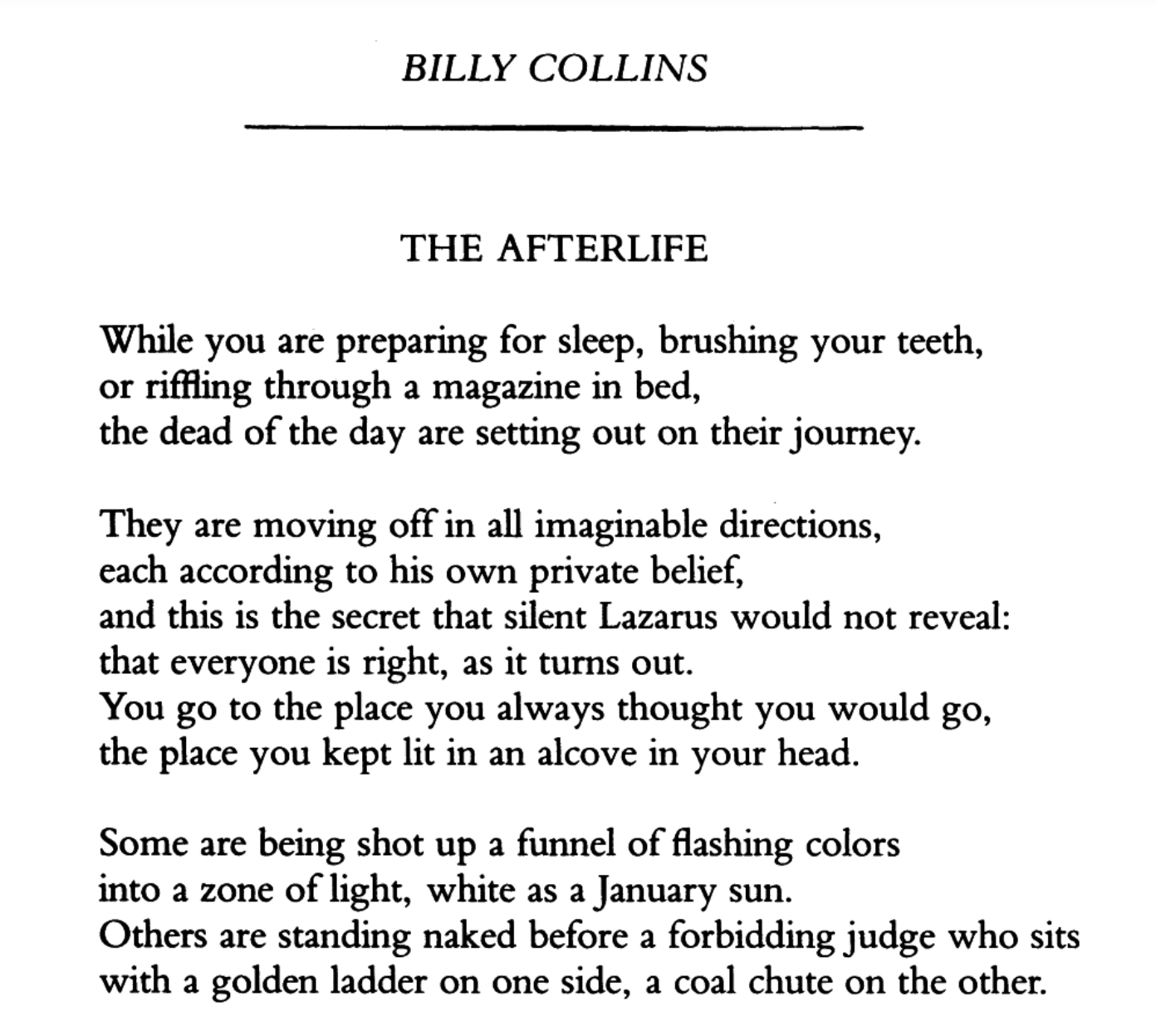
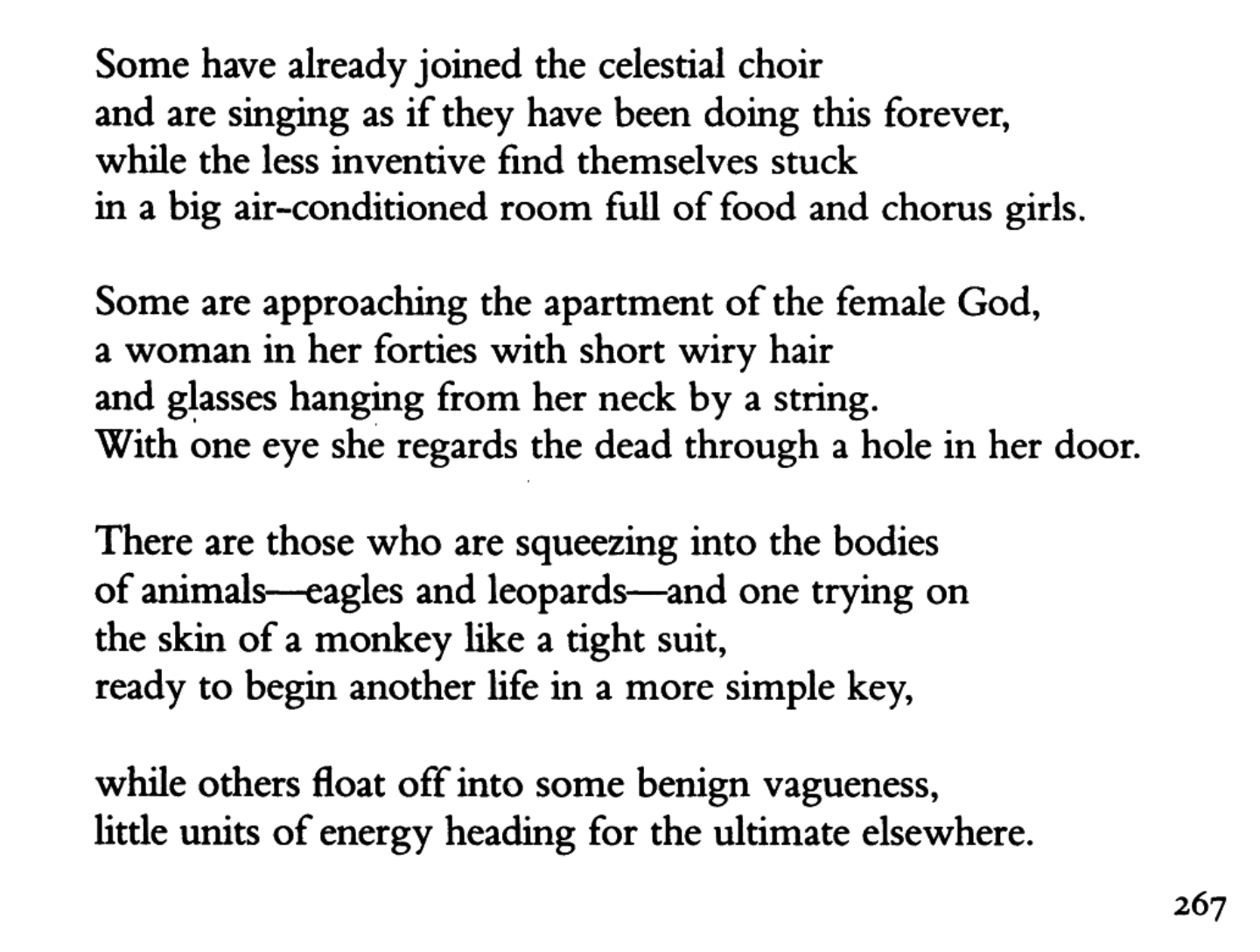

Posted in The Daily Poems | Tagged Billy Collins, Poetry Magazine, The Afterlife | Leave a Comment »
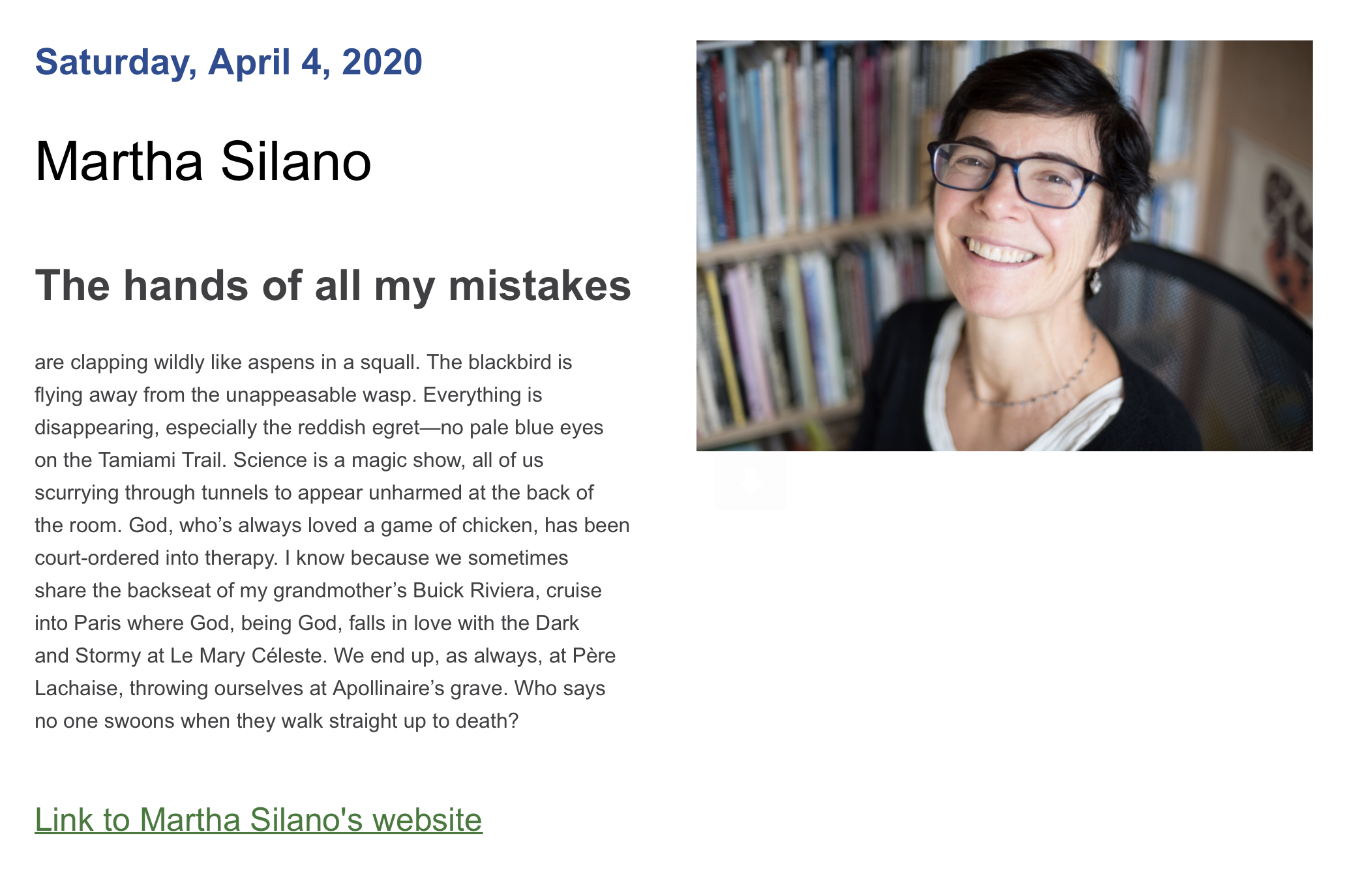
Posted in The Daily Poems | Tagged "the hands of all my mistakes", Martha Silano | Leave a Comment »

Posted in The Daily Poems | Tagged e.e. cummings, may my heart always be open, poem 53 | 1 Comment »
Go placidly amid the noise and haste,
and remember what peace there may be in silence.
As far as possible without surrender
be on good terms with all persons.
Speak your truth quietly and clearly;
and listen to others,
even the dull and the ignorant;
they too have their story.
Avoid loud and aggressive persons,
they are vexations to the spirit.
If you compare yourself with others,
you may become vain and bitter;
for always there will be greater and lesser persons than yourself.
Enjoy your achievements as well as your plans.
Keep interested in your own career, however humble;
it is a real possession in the changing fortunes of time.
Exercise caution in your business affairs;
for the world is full of trickery.
But let this not blind you to what virtue there is;
many persons strive for high ideals;
and everywhere life is full of heroism.
Be yourself.
Especially, do not feign affection.
Neither be cynical about love;
for in the face of all aridity and disenchantment
it is as perennial as the grass.
Take kindly the counsel of the years,
gracefully surrendering the things of youth.
Nurture strength of spirit to shield you in sudden misfortune.
But do not distress yourself with dark imaginings.
Many fears are born of fatigue and loneliness.
Beyond a wholesome discipline,
be gentle with yourself.
You are a child of the universe,
no less than the trees and the stars;
you have a right to be here.
And whether or not it is clear to you,
no doubt the universe is unfolding as it should.
Therefore be at peace with God,
whatever you conceive Him to be,
and whatever your labors and aspirations,
in the noisy confusion of life keep peace with your soul.
With all its sham, drudgery, and broken dreams,
it is still a beautiful world.
Be cheerful.
Strive to be happy.
Max Ehrmann
Posted in A Poet's Education, The Daily Poems | Tagged Desiderata, Max Ehrmann | Leave a Comment »

by Ben von Jagow
The flame dances,
beckons like a siren.
Come tomorrow,
the moth’s final motive
can be found
fossilized in the wax.

Ben von Jagow is a writer and poet from Ottawa, Canada currently living in Denmark. His work has appeared in such literary journals as The Mindful Word, Maudlin House, and The Literary Review of Canada. For more of Ben’s work visit benvj.com or follow him on Instagram: @aquacondor.
Posted in Uncategorized | Leave a Comment »

I will clench onto her hands, like a lost child who has been found.
I will gaze at her face so intently till a crimson colour seeps into her veins, and races towards her cheeks.
I will draw that other half of her smile, the one she once lost among a sea of strangers.
I will fold my hands and turn it into a boat when she drowns.
I will draw a sun on days they don’t shine for her.
I will always be at the corner of her mind having a smoke puffing its wisps blurring out every other stranger trying to seduce her.
I will kiss her tears and promise to be her guardian angel for eternity.
I will hold her hand and play Hide & Seek with her demons till they are afraid of my light.
I will keep painting her into existence with my raw words…
View original post 459 more words
Posted in Uncategorized | Leave a Comment »
BEREFT
Where had I heard this wind before
Change like this to a deeper roar?
What would it take my standing there for,
Holding open a restive door,
Looking down hill to a frothy shore?
Summer was past and the day was past.
Sombre clouds in the west were massed.
Out on the porch’s sagging floor,
Leaves got up in a coil and hissed,
Blindly struck at my knee and missed.
Something sinister in the tone
Told me my secret must be known:
Word I was in the house alone
Somehow must have gotten abroad,
Word I was in my life alone,
Word I had no one left but God.
Robert Frost
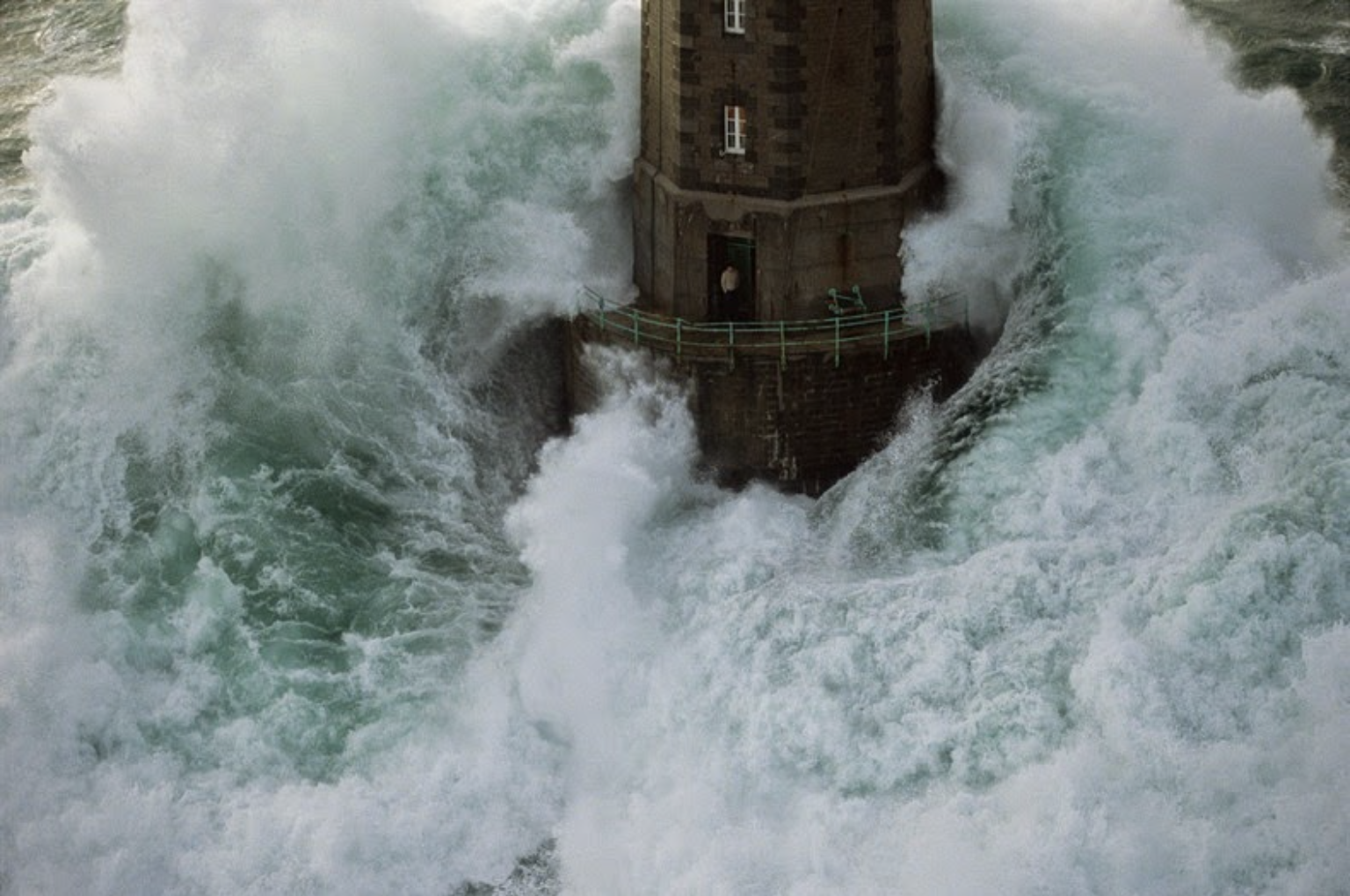
Photo credit: Jean Guichard
bereave [bih-reev]
verb (used with object), be·reaved or be·reft, be·reav·ing.
-to deprive and make desolate, especially by death (usually followed by of):
Illness bereaved them of their mother.
-to deprive ruthlessly or by force (usually followed by of):
The war bereaved them of their home.
– Obsolete . to take away by violence.
ORIGIN OF BEREAVE
before 900; Middle English bereven, Old English berēafian; cognate with Dutch berooven, German berauben, Gothic biraubōn. See be-, reave1
RELATED FORMS
be·reave·ment , noun
be·reav·er , noun
Posted in A Poet's Education, Images, The Daily Poems | Tagged Bereft, Robert Frost | Leave a Comment »



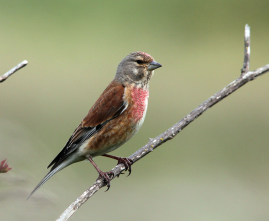
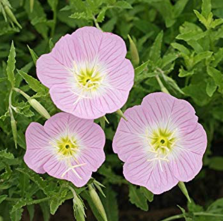

Posted in A Poet's Education, Images, The Daily Poems, The Reading Journals | Leave a Comment »

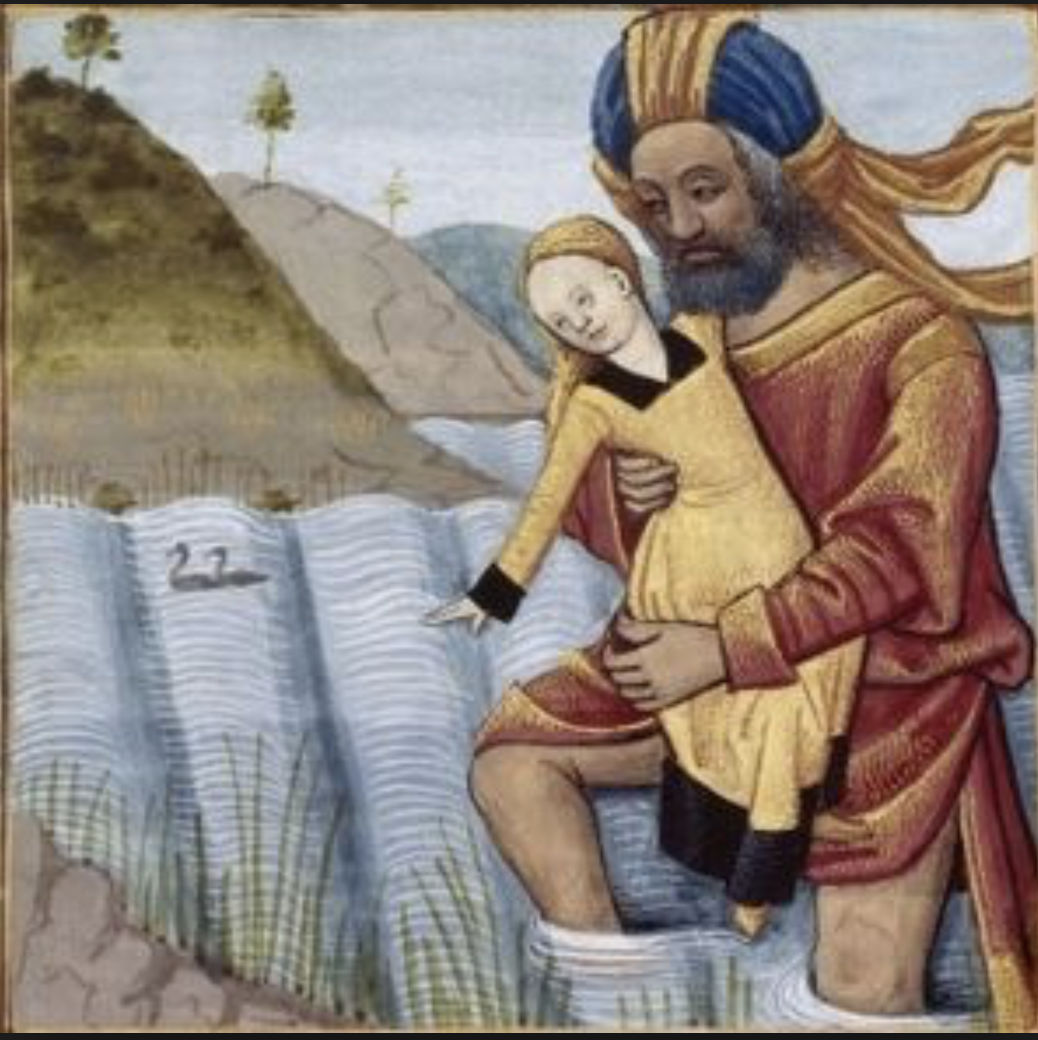
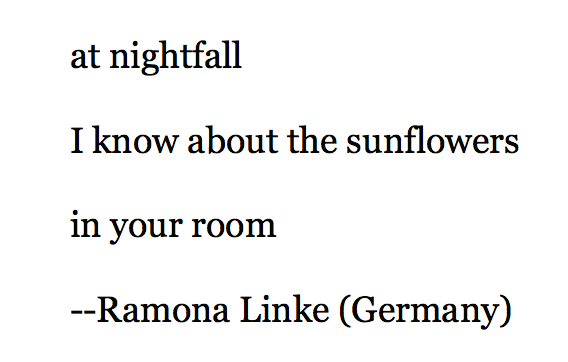



~ Gabriel Zech (Sollars Elementary)
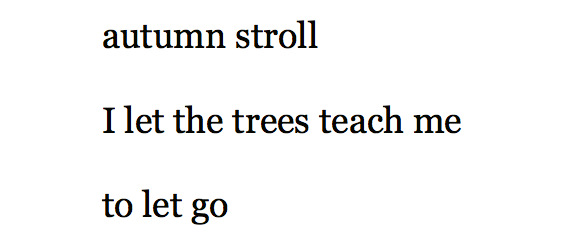 ~ Pat Davis (Pembroke, NH)

~ Lee Nash (France)
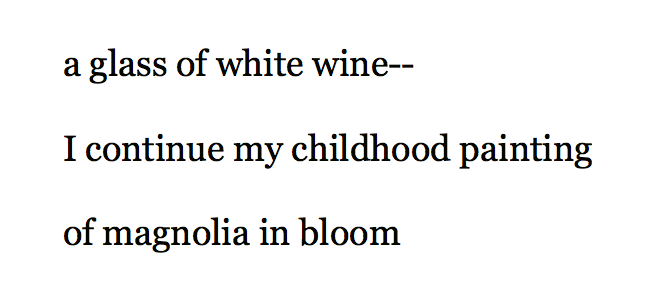
~ Ana Drubot (Bucharest)
Posted in A Poet's Education, Images, Poetry Lessons, The Daily Poems | Tagged Asahi Haikuist | Leave a Comment »
winter solstice
our son reads a fairy tale
to his unborn child

winter night
I dreamed your garden lights
were fireflies
I dreamed your garden lights
were fireflies
Reaching for green pears–
the pull
of an old scar
the pull
of an old scar
for her mother
bluets
roots and all
hazy moon
the nun begins her journey
with a backward glance
an open window
somewhere
a woman’s wordless song
sweet peas
tremble on the trellis
the bride’s “I will”
smooth garden bench
a woman embroiders
a unicorn
a woman embroiders
a unicorn

dew drops
on the dark rose
our reflections
on the dark rose
our reflections
yellow leaves
a girl plays hopscotch
by herself
a girl plays hopscotch
by herself
starlight
on the harp strings
Christmas Eve
on the harp strings
Christmas Eve
clay on the wheel I confess my faith

winter night
he patiently untangles
her antique silver chain
he patiently untangles
her antique silver chain
cathedral garden
cardinals in the birdbath
scatter drops of light
cardinals in the birdbath
scatter drops of light
the boy stands still
fingers splayed
above a starfish
fingers splayed
above a starfish
birdsong
through open windows
he lifts the veil
through open windows
he lifts the veil
night flight
a young man fast asleep
beside his cello
a young man fast asleep
beside his cello
dress by dress
the story of her life
day lilies close
the story of her life
day lilies close
soft Gullah
at the graveside…
blue glass shines
at the graveside…
blue glass shines

Posted in A Poet's Education, Images, Poetry Lessons, The Daily Poems, The Reading Journals | Tagged haiku, Peggy Willis Lyles | 1 Comment »

Posted in A Poet's Education, Images, Observations, The Daily Poems, The Reading Journals | Tagged haiku and the brain research, Haiku Foundation | Leave a Comment »


The farther we go
The harder it is
To rewrite the past
© 2018 Jason A. Muckley
Posted in Uncategorized | Leave a Comment »
4. a “turn,” or a sudden change of heart, if you will, found in the third line of the prose sections. Jeannine Hall Gailey goes from introducing a seemingly easy-going, cheerful visitor to a terrifying, blood-soaked seer in her haibun “Rescuing Seiryu, the Blue Dragon”:
You met the dragon in the garden. Sometimes he flies in circles outside your window. This morning he appeared as a young boy. / He shows you a vision of your parents, lying in a barn. With his face so close you smell hay. / He bleeds from the wounds of paper birds, from a swallowed curse. Can your healing rice cake keep him from death?
https://www.poets.org/poetsorg/text/more-birds-bees-and-trees-closer-look-writing-haibun
Posted in A Poet's Education, Rants, The Daily Poems | Tagged Aimee, blue dragon, haibun, jeannine hall gailey, Nezhukumatathil, rescuing seiryu | Leave a Comment »
Part I
On either side the river lie
Long fields of barley and of rye,
That clothe the wold and meet the sky;
And thro’ the field the road runs by
To many-tower’d Camelot;
The yellow-leaved waterlily
The green-sheathed daffodilly
Tremble in the water chilly
Round about Shalott.
Willows whiten, aspens shiver.
The sunbeam showers break and quiver
In the stream that runneth ever
By the island in the river
Flowing down to Camelot.
Four gray walls, and four gray towers
Overlook a space of flowers,
And the silent isle imbowers
The Lady of Shalott.
Underneath the bearded barley,
The reaper, reaping late and early,
Hears her ever chanting cheerly,
Like an angel, singing clearly,
O’er the stream of Camelot.
Piling the sheaves in furrows airy,
Beneath the moon, the reaper weary
Listening whispers, ‘ ‘Tis the fairy,
Lady of Shalott.’
The little isle is all inrail’d
With a rose-fence, and overtrail’d
With roses: by the marge unhail’d
The shallop flitteth silken sail’d,
Skimming down to Camelot.
A pearl garland winds her head:
She leaneth on a velvet bed,
Full royally apparelled,
The Lady of Shalott.
Part II
No time hath she to sport and play:
A charmed web she weaves alway.
A curse is on her, if she stay
Her weaving, either night or day,
To look down to Camelot.
She knows not what the curse may be;
Therefore she weaveth steadily,
Therefore no other care hath she,
The Lady of Shalott.
She lives with little joy or fear.
Over the water, running near,
The sheepbell tinkles in her ear.
Before her hangs a mirror clear,
Reflecting tower’d Camelot.
And as the mazy web she whirls,
She sees the surly village churls,
And the red cloaks of market girls
Pass onward from Shalott.
Sometimes a troop of damsels glad,
An abbot on an ambling pad,
Sometimes a curly shepherd lad,
Or long-hair’d page in crimson clad,
Goes by to tower’d Camelot:
And sometimes thro’ the mirror blue
The knights come riding two and two:
She hath no loyal knight and true,
The Lady of Shalott.
But in her web she still delights
To weave the mirror’s magic sights,
For often thro’ the silent nights
A funeral, with plumes and lights
And music, came from Camelot:
Or when the moon was overhead
Came two young lovers lately wed;
‘I am half sick of shadows,’ said
The Lady of Shalott.

Part III
A bow-shot from her bower-eaves,
He rode between the barley-sheaves,
The sun came dazzling thro’ the leaves,
And flam’d upon the brazen greaves
Of bold Sir Lancelot.
A red-cross knight for ever kneel’d
To a lady in his shield,
That sparkled on the yellow field,
Beside remote Shalott.
The gemmy bridle glitter’d free,
Like to some branch of stars we see
Hung in the golden Galaxy.
The bridle bells rang merrily
As he rode down from Camelot:
And from his blazon’d baldric slung
A mighty silver bugle hung,
And as he rode his armour rung,
Beside remote Shalott.
All in the blue unclouded weather
Thick-jewell’d shone the saddle-leather,
The helmet and the helmet-feather
Burn’d like one burning flame together,
As he rode down from Camelot.
As often thro’ the purple night,
Below the starry clusters bright,
Some bearded meteor, trailing light,
Moves over green Shalott.
His broad clear brow in sunlight glow’d;
On burnish’d hooves his war-horse trode;
From underneath his helmet flow’d
His coal-black curls as on he rode,
As he rode down from Camelot.
From the bank and from the river
He flash’d into the crystal mirror,
‘Tirra lirra, tirra lirra:’
Sang Sir Lancelot.
She left the web, she left the loom
She made three paces thro’ the room
She saw the water-flower bloom,
She saw the helmet and the plume,
She look’d down to Camelot.
Out flew the web and floated wide;
The mirror crack’d from side to side;
‘The curse is come upon me,’ cried
The Lady of Shalott.

Part IV
In the stormy east-wind straining,
The pale yellow woods were waning,
The broad stream in his banks complaining,
Heavily the low sky raining
Over tower’d Camelot;
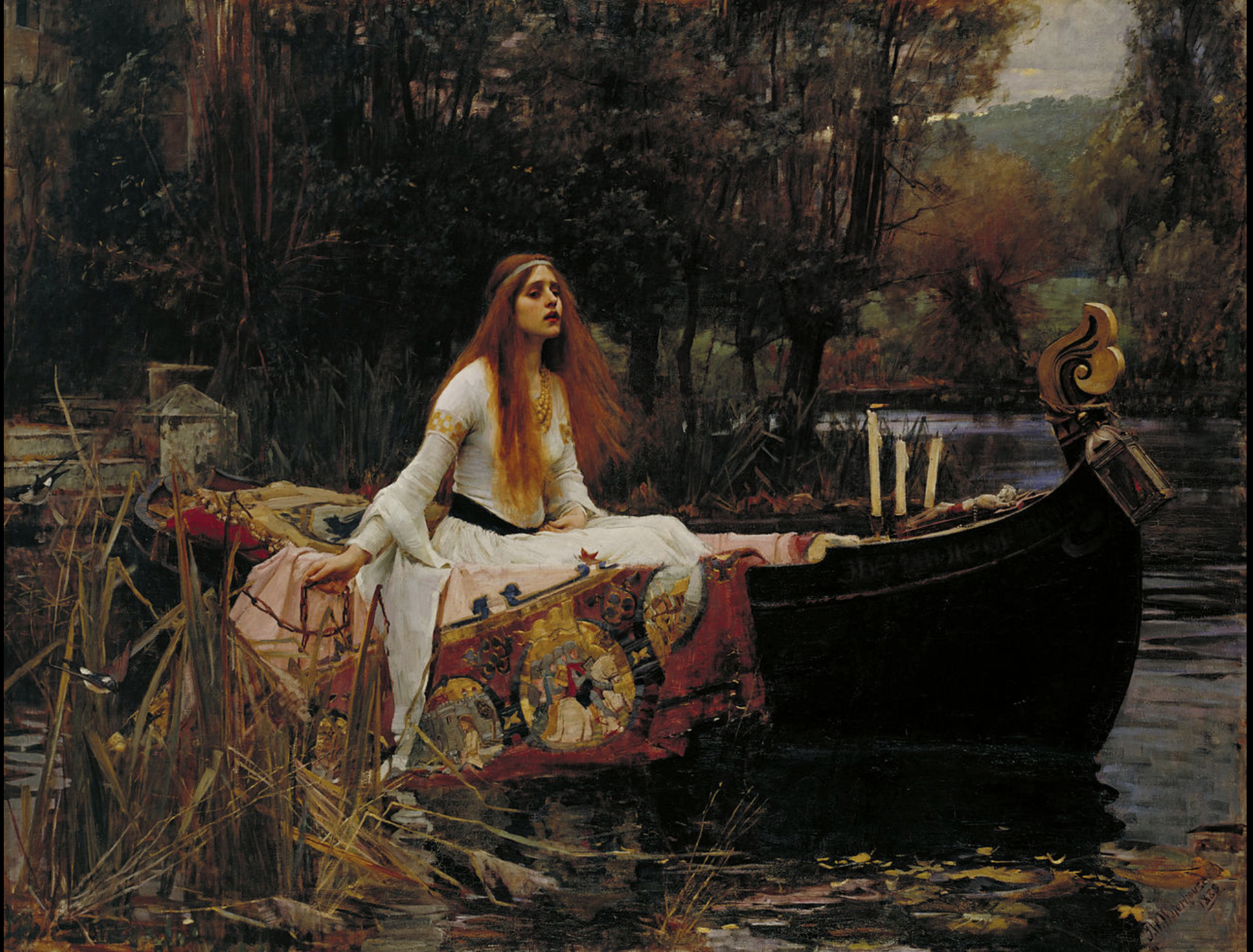
Outside the isle a shallow boat
Beneath a willow lay afloat,
Below the carven stern she wrote,
The Lady of Shalott.
A cloudwhite crown of pearl she dight,
All raimented in snowy white
That loosely flew (her zone in sight
Clasp’d with one blinding diamond bright)
Her wide eyes fix’d on Camelot,
Though the squally east-wind keenly
Blew, with folded arms serenely
By the water stood the queenly
Lady of Shalott.
With a steady stony glance—
Like some bold seer in a trance,
Beholding all his own mischance,
Mute, with a glassy countenance—
She look’d down to Camelot.
It was the closing of the day:
She loos’d the chain, and down she lay;
The broad stream bore her far away,
The Lady of Shalott.
As when to sailors while they roam,
By creeks and outfalls far from home,
Rising and dropping with the foam,
From dying swans wild warblings come,
Blown shoreward; so to Camelot
Still as the boathead wound along
The willowy hills and fields among,
They heard her chanting her deathsong,
The Lady of Shalott.
A longdrawn carol, mournful, holy,
She chanted loudly, chanted lowly,
Till her eyes were darken’d wholly,
And her smooth face sharpen’d slowly,
Turn’d to tower’d Camelot:
For ere she reach’d upon the tide
The first house by the water-side,
Singing in her song she died,
The Lady of Shalott.
Under tower and balcony,
By garden wall and gallery,
A pale, pale corpse she floated by,
Deadcold, between the houses high,
Dead into tower’d Camelot.
Knight and burgher, lord and dame,
To the planked wharfage came:
Below the stern they read her name,
The Lady of Shalott.
They cross’d themselves, their stars they blest,
Knight, minstrel, abbot, squire, and guest.
There lay a parchment on her breast,
That puzzled more than all the rest,
The wellfed wits at Camelot.
‘The web was woven curiously,
The charm is broken utterly,
Draw near and fear not,—this is I,
The Lady of Shalott.’
Posted in A Poet's Education, Images, The Daily Poems | Tagged Alfred Lord Tennyson, Lady of Shallott | Leave a Comment »
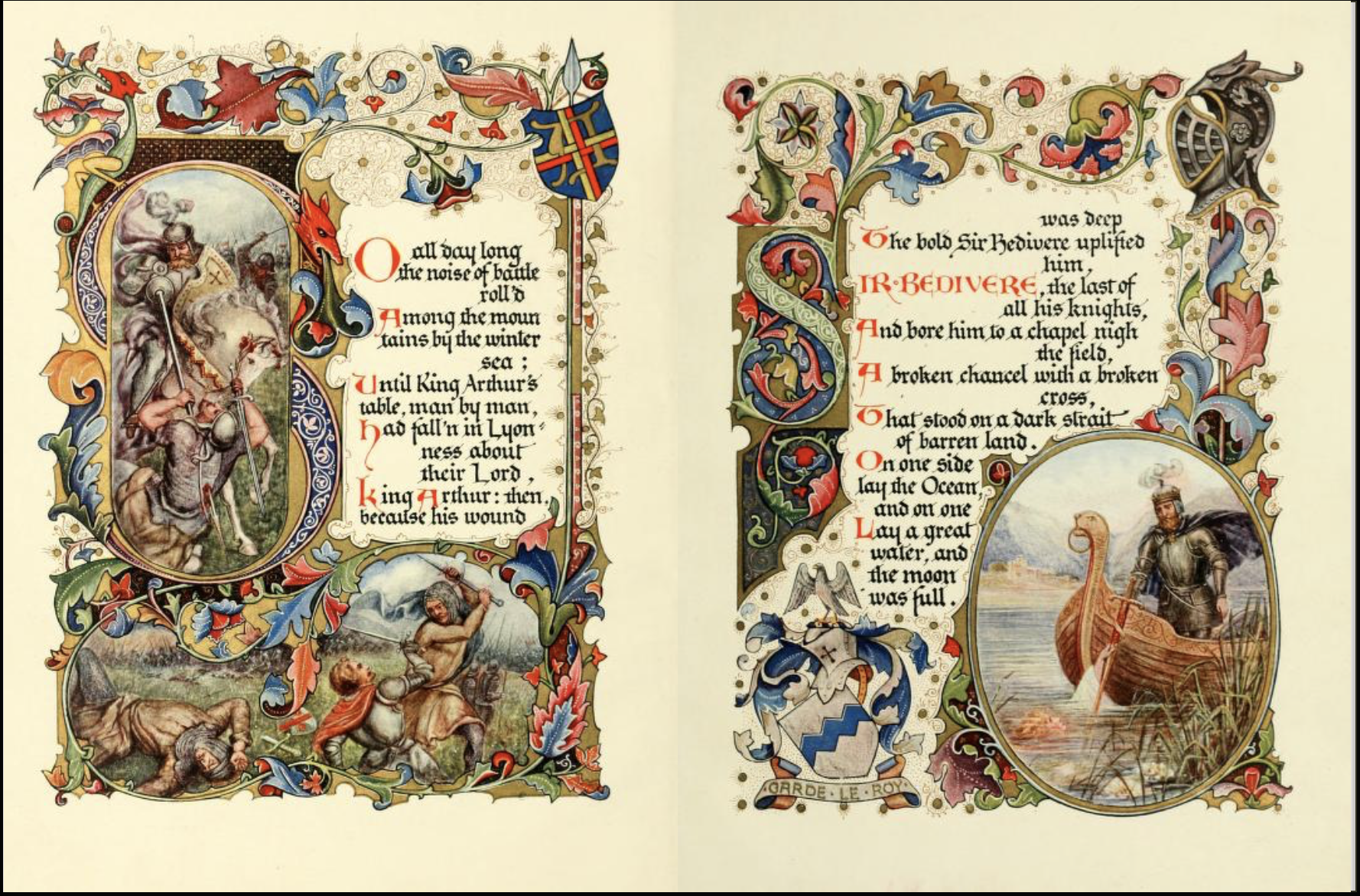
Posted in A Poet's Education, Images, The Daily Poems | Tagged Alfred Lord Tennyson, illuminated, Morte d'Arthur | Leave a Comment »
 THE POETRY PLACE